
Institute for Sustainable Future News: Rural communities across the Midwest, whose agricultural economies and energy infrastructure are frequently threatened by extreme weather events such as hailstorms, heat waves and high winds, are getting a new lifeline through a National Science Foundation–funded project at Purdue University.
The NSF’s Regional Resilience Innovation Incubator (R2I2): Midwest Agrivoltaics for Resilient Communities (MARC), supported under grant #2519425, is designed to help these communities become more resilient by combining agriculture with solar energy — to improve resilience from local to national levels. This phase 1 grant positions the team to compete for a Phase 2 grant worth up to $15M for an additional 5 years.
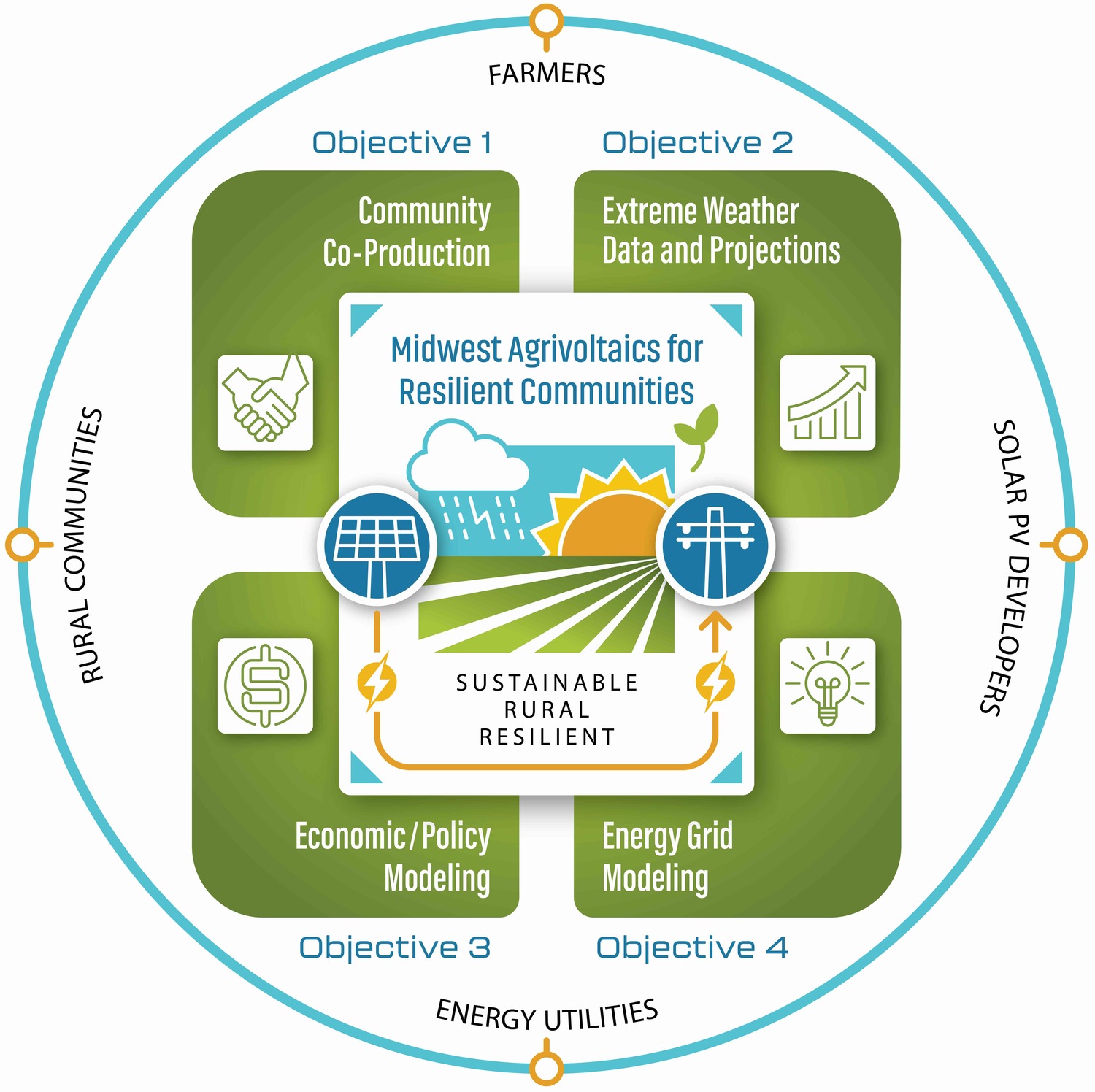
Image: Institute for a Sustainable Future
Agrivoltaics, which allows the dual use of land for agricultural production and solar energy generation, holds great promise to diversify farm income, reduce power outages, and increase energy production as energy demand soars. But agrivoltaics systems have seen slow adoption in the Midwest due to uncertainties about land use trade-offs, lack of trusted information about community impacts and benefits, and concerns from farmers and communities about economic viability and performance under extreme weather. The incubator intends to bring together community members, stakeholders and experts to fill those gaps.